Tenancy management
A tenancy is a partnership between the occupier and the manager of the property. A successful partnership results from great communication between both parties. Not only are first impressions crucial but tenants will then need regular contact, help and support throughout the years of living in the property.
If you are managing the property yourself, you need to be on hand and accessible to help your tenants with any questions and offer speedy resolutions when issues arise. This is why all of our property managers work in an office no more than 15 minutes away from the properties they manage.
Tenants are excited when they first move into their new home and want to be proud of where they live. Great property management is about enhancing this feeling, with good communication from check-in to check-out.
Our aim is to help your tenant keep their property in the best possible condition. Whilst they are in charge of the everyday upkeep of their home, we are here to stay on top of maintenance with your tenants as our eyes and ears.
The property needs to be fully prepared before the new tenants move in and it is essential that everything is in working order with access to all manuals and useful information, as well as being professionally cleaned.
Where a property is let to sharers under a joint tenancy, notice given by one tenant is sufficient to bring the tenancy to an end for all tenants, even without their consent. You may choose to accept notice on behalf of all tenants, or alternatively, grant a new tenancy to the remaining tenants and any replacement tenant. Our specialist team is on hand to guide you through this process.
Property management
Just like your own home, your investment will need regular servicing, updating and maintenance. Making a success of your investment needs a plan, a list of routine jobs and good habits. This is best approached with a preventative maintenance plan.
This proactive approach has several advantages, such as:
- Maintaining a better relationship with the tenant
- Helping tenants look after the property
- Keeping costs down in the long run
- Making sure that the property remains attractive to tenants
A preventative maintenance plan differs from one property to the next - a house or a converted flat being the most complex but even a brand-new flat needs regular work, especially if your property has a garden.
We have an in-house team of maintenance engineers who are on hand to keep costs down and help stay on top of the little to medium sized jobs ranging from loose toilet seats and hinges to jet-washing patios. We can also help prolong the life of the boiler by organising a service at the same time as the annual gas safety certificate is carried out. These preventative measures reduce the likelihood of costly repairs and put the tenants mind at ease.
The rewards are reliable, long-term tenants, steady rental income and your asset continuing to gain value.
Safety & legal compliance
The work we do in finding the tenant, setting up the tenancy agreement, helping arrange appropriate certificates and check-in formalities, covers you for many of the risks at the start of the tenancy. There are now over 170 pieces of legislation for a Landlord to keep on top of, the key ones being:
All rented properties require an Electrical Installation Condition Report to be carried out every five years. You will also need to provide a copy to your tenant within 30 days of the certificate being issued. Please remember to check the Competent Person Register before instructing a contractor, to confirm that they are competent and qualified to carry out the EICR and any remedial works.
Any property containing a gas supply needs to have an annual Landlord’s gas safety inspection. You will also need to provide a copy to your tenant within 28 days of the certificate being issued, otherwise you may not be able to serve notice to end the tenancy. If there is a communal boiler in the building; supplying heat and hot water to the property, you will need to provide a copy of the communal boiler gas safety certificate to your tenant.
Legionella can develop when water becomes stagnant. If your property has been empty for a while, we recommend carrying out a Legionella risk assessment.
Regular visits to the property during the tenancy will help you make sure the property is being looked after, there are no maintenance issues the tenant has missed and the smoke alarms are in working order.
Your property needs to be fitted with a smoke alarm on each floor and a carbon monoxide alarm in any room with a gas appliance. Both smoke and carbon monoxide alarms will need to be tested and working on the day of move-in and whenever you visit the property. Any expired alarms must be replaced before the tenancy starts.
If you have a more complex fire alarm system in your property, it may need six monthly servicing with a specialist contractor and tenants will need to be provided with information on how to operate and test the alarm system when they first move into their home. Failure to do this could invalidate your insurance policy.
Open plan layouts, conversions and refurbishments carried out without Building Control approval can unintentionally result in the creation of ‘unsafe’ rooms. An ‘unsafe’ room is typically a bedroom, where the only means of escape is through another room, such as a kitchen, which would trap the tenants if a fire were to occur there.
To ensure tenants are kept safe in the event of a fire, appropriate measures such as alternative escape routes, automatic fire detection and warning systems, fire doors or other fire safety provisions would need to be installed. Where these additional fire safety measures are not in place, the ‘unsafe’ room must not be used as a bedroom.
Health and safety standards for rented homes
The Housing Health and Safety Rating System (HHSRS) is the framework used by local authority environmental health officers to assess housing conditions. Introduced under the Housing Act 2004, it is the system councils use when inspecting residential properties.
During an inspection, officers assess potential hazards within the property using the HHSRS and apply a points-based scoring system to determine the level of risk. If the assessment identifies a Category 1 hazard, the local authority is legally required to take action to ensure the issue is addressed. Where a Category 2 hazard is identified, the authority has the discretion to take action if it considers it appropriate. Hazards may arise from a variety of issues, such as damp and mould, excess cold, fire safety risks, overcrowding, inadequate lighting, pest infestations or problems with water supply, sanitation and drainage.
Once hazards are identified, the local authority may use its enforcement powers to require improvements or remedial works to be carried out, within specific timescales. In some cases, a Prohibition Order may be issued. This can restrict or prevent occupation of all or part of a property, for example, where a property is overcrowded or where necessary repairs cannot safely be carried out while the property is occupied. Failure to comply with any notice may result in a civil penalty of up to £40,000.
The central principle of the HHSRS is that a home, including the building itself, any outbuildings, gardens or outdoor areas and the means of access, should provide a safe and healthy living environment for tenants.
Our Property Management team are on hand to act quickly with minimal disruption should an issue arise, they are available to offer expert advice, ongoing support and excellent solutions. Landlords choose our Property Management service because it comes highly rated, and the fact that their personal Property Manager is never more than 15 minutes away from any property in their portfolio provides peace of mind.
Houses of multiple occupancy & licensed properties
We recommend staying in regular contact with the Local Authority to understand any changes to licensing schemes that affect your property.
If you rent to three or more unrelated tenants it’s likely that your property will be considered a ‘House in Multiple Occupation’ (HMO) and there are more legal requirements for this type of let. In some instances, regardless of how many tenants you have, you may also require a licence from your local authority in order to rent your property out. Licensing schemes are constantly changing, so we are here to help you keep on top of new schemes or amendments to existing ones.
There are a few differences when you manage a property with a licence or a HMO:
- You may need additional certificates such as a fire risk assessment and PAT test
- There is a requirement for more frequent formal inspections when the property is licensed
- Fire safety is very important and you, not the tenant, will need to regularly test and service any fire safety precautions; such as, smoke alarms, fire alarm systems, heat detectors, fire blankets, fire doors, thumb turn locks and extinguishers to ensure that they remain effective if there is a fire
- The licence may require you to send a receipt to your tenant as soon as you receive a rental payment
- The licence, certificates and your contact details will need to be displayed prominently in the property
- Provide adequate provision for refuge storage and recycling
It is quite usual for the local authority to inspect your property and check its condition. They particularly look for issues with damp, mould and condensation, fire safety, waste management, security and check that the right number of people are living in the property. If they have any concerns they can issue an improvement notice which has to be acted on immediately.
Not having a licence when one is required or not following the conditions of a licence is a criminal offence and can lead to substantial fines. Managing a HMO or a property with a licence can be very time consuming and requires prompt action. We strongly recommend you ask us to manage any HMO or licensed properties.
Additional fire safety
If you own a property which shares a communal hallway with one or more residential properties, you will need to establish who the Responsible Person for the building is - which will normally be the freeholder or block manager, as they will be responsible for fire safety in the common parts.
Types of fire safety measures required in the common parts could be:
- Annual Fire Risk Assessments
- Fire alarm systems, fire doors, emergency lighting, sprinkler systems and EICR for the common parts
- Testing and servicing alarms and fire safety equipment regularly - and maintaining records
- Providing a copy of the Fire Evacuation Plan and fire safety information to the tenants annually
- Attaching the Fire Evacuation Plan to the wall in the common parts of each floor
If you own a property in a building that is at least 18 metres or seven storeys high, and contains at least two residential units, please speak to us for further advice.
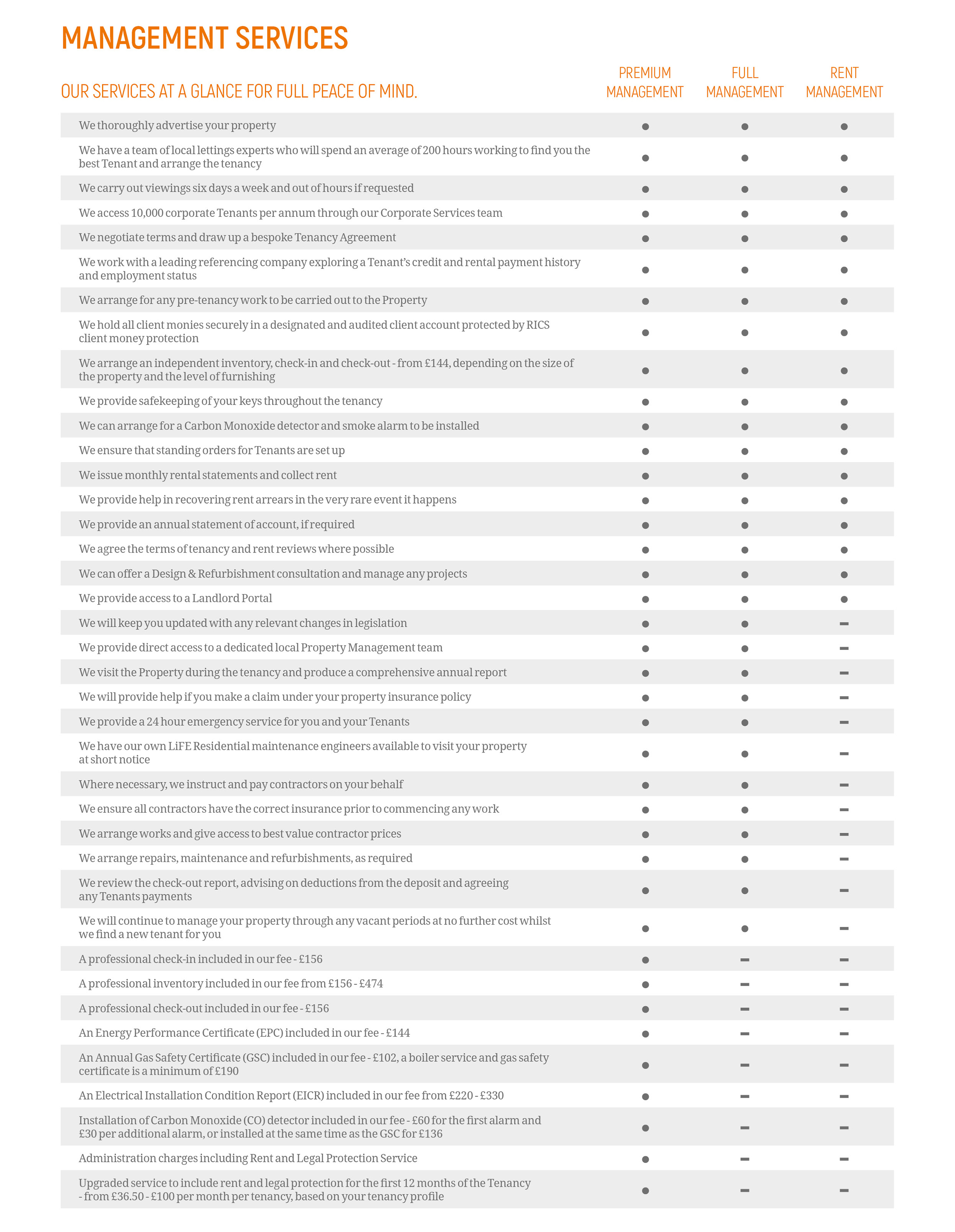
We have partnered with our existing tenant referencing partner Let Alliance, a leading provider in the lettings industry, to provide rent and legal protection. This means that in the unfortunate event that your tenant stops paying rent or commits any breach of the terms of their tenancy, we will be able to claim to recover your losses, up to and in line with the policy limits. This added layer of security is designed to safeguard your rental income and provide expert legal support in times of need. Please speak to us if you would like to benefit from this enhanced service.
We would strongly recommend taking out both Building and Contents insurance when letting out a property, to provide you with complete protection. Buildings insurance covers the cost of repairing the structure of your property, for example, damage caused by bad weather, fallen trees, frozen or burst pipes, fires and explosions. Contents insurance protects everything you have supplied in your property, such as electrical appliances, white goods, furniture, carpets etc.
Help, advice & ongoing support
We want your relationship with the tenant to be a success and our objective is to help you keep the tenant in occupation for as long as possible. We will be right behind you throughout the tenancy and will stay in regular contact with you.
Our role is to make sure rent is paid and that you and the tenant are happy. Should your tenant wish to give notice to end the tenancy or change the Tenancy Agreement in any way, we ask that you contact us immediately. Our agreements are finely tuned to look after your best interests and we are keen to manage these processes for you.
By following the advice given, your property will remain in good condition and will rent quickly without a void period, should you need to find new tenants.